The Continued Wait for the 'Newey Effect' in F1
Newsroom
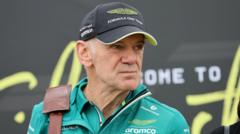
Formula 1 entered its summer break ahead of the Dutch Grand Prix, scheduled for 21-23 August 2026. Despite this pause, BBC Sport F1 correspondent Andrew Benson remains available to address questions regarding the season's progress.
Aston Martin's new package has shown promise, particularly with Fernando Alonso helping the team progress from the first qualifying phase during the Hungarian Grand Prix. However, the team is still significantly below expectations, raising questions about the anticipated 'Newey effect' from Adrian Newey, who is often heralded as one of the best designers in the sport.
One reason for the slower-than-expected success of the Aston Martin-Honda partnership lies in the timeline of the 2026 aerodynamic regulations released on 2 January 2025. Newey officially started his position as managing technical partner at Aston Martin on 2 March 2025. Upon joining, he instructed the team to abandon their previous design work and shift to his new architectural plan, putting them nearly two months behind their competitors. The situation worsened when the wind tunnel for car modelling was not operational until mid-April, effectively setting the team back by four months. Furthermore, Aston Martin discovered in November last year that Honda was lagging in its engine design, compounding the difficulties observed at the season's outset, where the car's competitiveness and reliability were inadequate.
Since then, Aston Martin has taken steps, as Newey articulated, to "overhaul how we work," enhancing their organizational structure and systems while rethinking the car's design. The revised car, which made its debut in Hungary, is reportedly lighter and possesses improved downforce, showing a lap time reduction of around two seconds.
The first update for the Honda engine is anticipated at the Dutch Grand Prix post-summer break, which should close some of the performance gap to the front-running engines. However, a fully realized Newey design is not expected until 2027, and its success will also depend significantly on Honda's performance with its 2027 engine.
Inquiries have also arisen about preparations for the newly added Malaysian Grand Prix. Although it is known for its challenging tropical conditions, drivers will approach preparation similarly to how they would for the Singapore Grand Prix the following week. The main challenge arises due to the scheduling of races, as teams must adapt from European time to local time in Malaysia, creating a logistical challenge following the Azerbaijan race. Nevertheless, drivers, being elite athletes, are well-equipped to handle such transitions.
The potential for the F1 season to conclude in Europe raises concerns about colder temperatures affecting race dynamics regarding grip. With the situation in the Middle East complicating the closing races in Qatar and Abu Dhabi due to ongoing tensions, a possible resolution has been to run a race in Imola, Italy, in early December. The weather there could be chilly, but F1 president Stefano Domenicali noted that it might not be more frigid than Las Vegas during a night race. The complexity of scheduling and logistical requirements means that F1 is likely to finish its season in Europe, hoping for survivable weather conditions.
Source : bbc.co.uk.